
The Hand That Feeds, The Hand That Kills

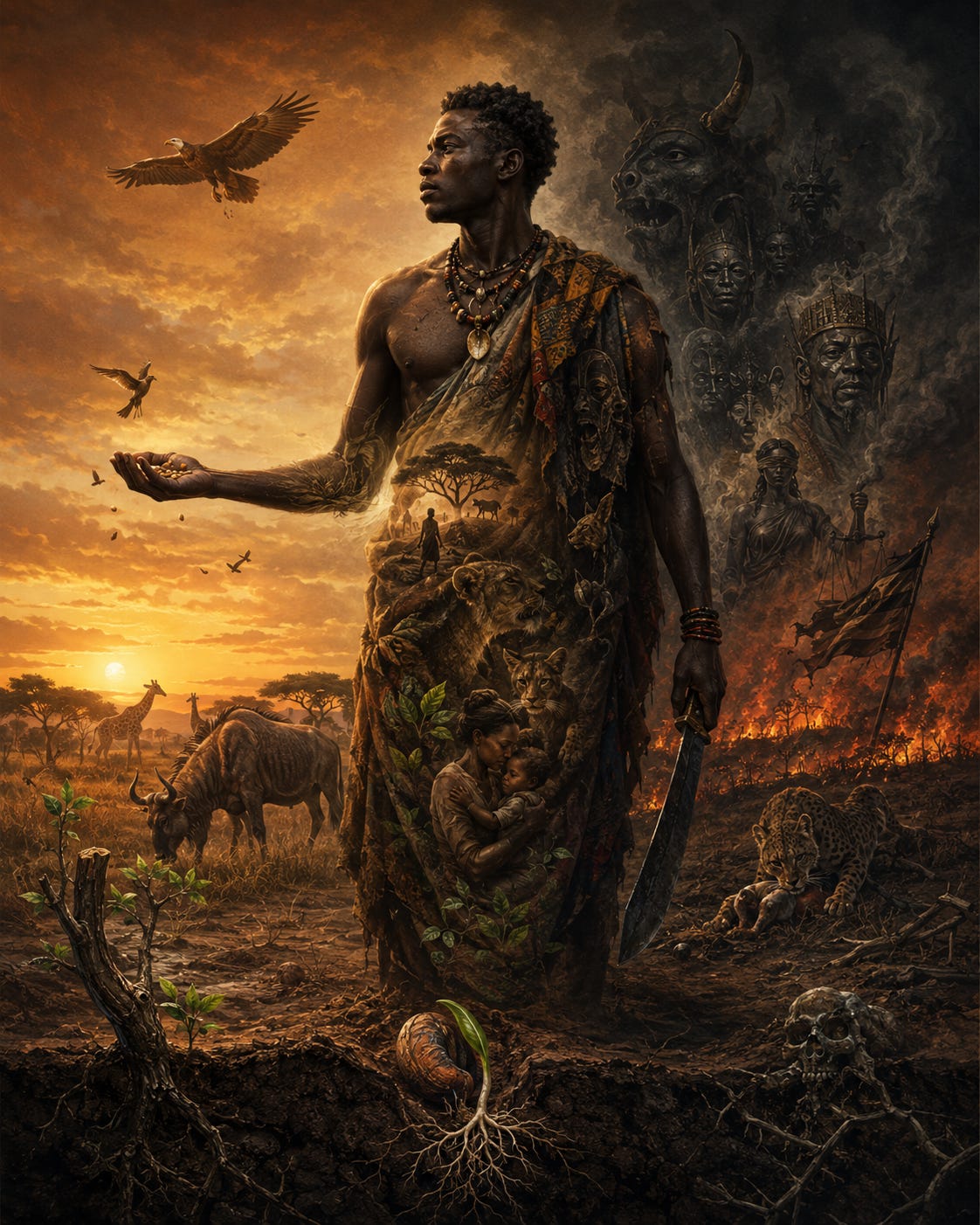
There is neither good nor evil, perhaps. Or maybe there is, but not in the simple way we have been taught to imagine it.
Maybe people are out living their lives the best way they know how. Sometimes their living is to your advantage; sometimes it is to theirs. Sometimes their survival feeds you; sometimes it feeds on you. For creatures who seem to embody the traits of all other creatures, what we manifest is subject to the moment. One moment we are grazing quietly like cattle, taking only what the field offers. Another moment we are hunters, snatching prey from another hunter so we can feed our own offspring. Another moment we are like the pussy cat, not merely killing the mouse, but toying with it first, exercising power beyond necessity.
This is the strange burden of being human. We carry the predator, the grazer, the builder, the trickster, the healer, the coward, the protector, the parasite, and the saint. What appears in a given moment depends on hunger, fear, memory, opportunity, power, love, humiliation, training, and consequence.
Maybe, just maybe, good and evil are constructs of our imagination, names we created as we tried to rationalise the complexity of our existence. Maybe they are not fixed substances sitting inside people like organs. Maybe they are names we give to outcomes, intentions, wounds, fears, hungers, loyalties, and consequences after they have already passed through the human being.
A lion does not become evil because it kills. A cat does not become evil because it toys with a mouse. A man does not become holy simply because his action benefits someone. The same act can look like survival from one side and cruelty from the other. A mother stealing food may be a criminal to the shopkeeper, a saviour to her child, and a symptom to the society that left her with no clean option.
So yes, human beings are not simple moral machines. Life is too complicated for that. But perhaps the biggest mistake we have made is not that we imagined good and evil. The mistake may be that we standardised them into a template our species could follow.
We turned living moral judgment into categories. Good people. Bad people. Heroes. Villains. Sinners. Saints. Criminals. Saviours. We made morality neat because complexity frightened us. But life is messier than that. A man can be generous at home and monstrous at work. A nation can preach peace while selling weapons. A parent can wound a child while sincerely believing they are teaching discipline. A revolutionary can begin in justice and end in domination.
So perhaps good and evil are not imaginary. Perhaps they are relational names.
Good is what preserves life, dignity, balance, truth, and becoming.
Evil is what destroys life, dignity, balance, truth, and becoming — especially when one knows, or should know, the damage being done.
But even that is not simple.
It is easy to consider evil as that which destroys life. Yet sometimes, some life needs to be destroyed in order for better to come. As it may be said, destruction is an essential part of construction. A forest burns and returns richer. A seed is buried and broken before it becomes a tree. A rotten branch must sometimes be cut off to save the trunk. The human body itself survives by killing invading organisms. Nature does not treat destruction as an interruption of life. Often, destruction is one of the ways life renews itself.
Destruction alone cannot be the definition of evil; the deeper question is mandate.
Who has the right to destroy?
Who has the wisdom to decide what must end?
Who carries the burden of what follows after the ending?
That is where human beings become dangerous. Not because we destroy, but because we learn to describe our destruction as destiny, duty, cleansing, progress, justice, divine will, national security, market reform, civilisation, or necessary sacrifice.
And once destruction is given a sacred name, responsibility evaporates.
A man kills, but says God commanded it.
A nation invades, but says history required it.
A ruler imprisons, but says order demanded it.
A corporation exploits, but says the market decided.
A mob burns, but says justice was speaking.
In every case, the hand is human, but the blame is outsourced.
Probably that is where we invented gods, or at least where gods became politically useful. Not merely as objects of worship, but as moral shelters. We needed somewhere to place the weight of decisions our conscience could not carry. We needed a voice higher than our own to authorise the knife, the fire, the exile, the conquest, the punishment, the cleansing.
And for our gods to be gods, we gave them a nemesis. One who embodies evil. A devil. A serpent. A demon. An enemy. A darkness. Something external to blame for the violence that came from within us.
With that, we got something to blame for who we are, we split ourselves.
The good we claim as virtue.
The evil we assign to the other.
The blood we spill becomes necessity.
The blood spilled by others becomes wickedness.
That may be one of humanity’s oldest tricks: we do not deny violence; we rename our own violence as order.
But the naked truth remains.
It is a man who takes another man’s life.
It is a man who signs the order.
It is a man who sharpens the blade.
It is a man who looks away.
It is a man who later says, “I had no choice.”
The same way it is a man who feeds another man. It is a man who opens the door. It is a man who shelters the stranger. It is a man who forgives the debt. It is a man who holds another man’s hand at the edge of death. Yet when life is given, we are quick to claim the goodness. When life is taken, suddenly it is never us.
We say the devil tempted us.
We say God commanded us.
We say the system required us.
We say the market forced us.
We say history gave us no option.
We say the enemy left us no choice.
But somewhere beneath all those explanations, there is still a human hand.
And perhaps that is why the question of good and evil refuses to die. The categories are not perfect, yet we need language for consequences. If we say there is no good or evil at all, then the powerful get a free pass. Every cruelty becomes “context.” Every betrayal becomes “survival.” Every empire becomes “just people doing what they knew.” That may explain behaviour, but it must not excuse consequence.
Maybe the real problem is not that we created moral language. The problem is that we allowed moral language to become a hiding place.
There may be moments where destruction truly is unavoidable. A rotten system may need to fall. A violent attacker may need to be stopped. A harmful practice may need to be ended. But even then, the honest person does not hide behind God, fate, ideology, or history. The honest person says:
I chose this. I may have believed it necessary, but I chose it. And I must answer for what it costs.
That, perhaps, is the difference between necessary destruction and evil.
Necessary destruction carries grief.
Evil carries appetite.
Necessary destruction is reluctant.
Evil becomes fluent.
Necessary destruction tries to restore balance.
Evil learns to enjoy imbalance when it benefits the destroyer.
Necessary destruction accepts responsibility.
Evil searches for a mask.
So maybe evil is not simply destruction. Evil is destruction without honest responsibility. Destruction disguised as innocence. Destruction that refuses to mourn. Destruction that kills and then invents a god, a devil, a law, a market, a flag, or a theory to keep the killer’s hands clean.
And maybe good is not simply kindness. Maybe good is the courage to remain answerable for the life one affects. To feed without pretending to be a saviour. To destroy, where destruction is truly unavoidable, without pretending the blood belongs to someone else. To know that even necessary harm leaves a mark on the hand that performs it.
We are neither good nor evil by nature; we are capable. Human beings are capable!
And what we become depends on what the moment awakens in us, and what we have disciplined ourselves to refuse.
That is why morality cannot be reduced to templates. It has to be cultivated like judgment. Like taste. Like courage. Like restraint. Like the ability to pause before naming our appetite as justice.
Maybe the question is not, “Is this person good or evil?”
Maybe the better question is:
What condition brought this version of me forward — and what kind of world keeps rewarding it?
And perhaps an even harder question follows:
When I destroy, who do I blame?
Because the terrifying thing is that we may not have invented evil only to explain what we hate.
We may have invented it to avoid seeing what we are capable of.