
The Washbay
Decay is natural. Neglect is optional.

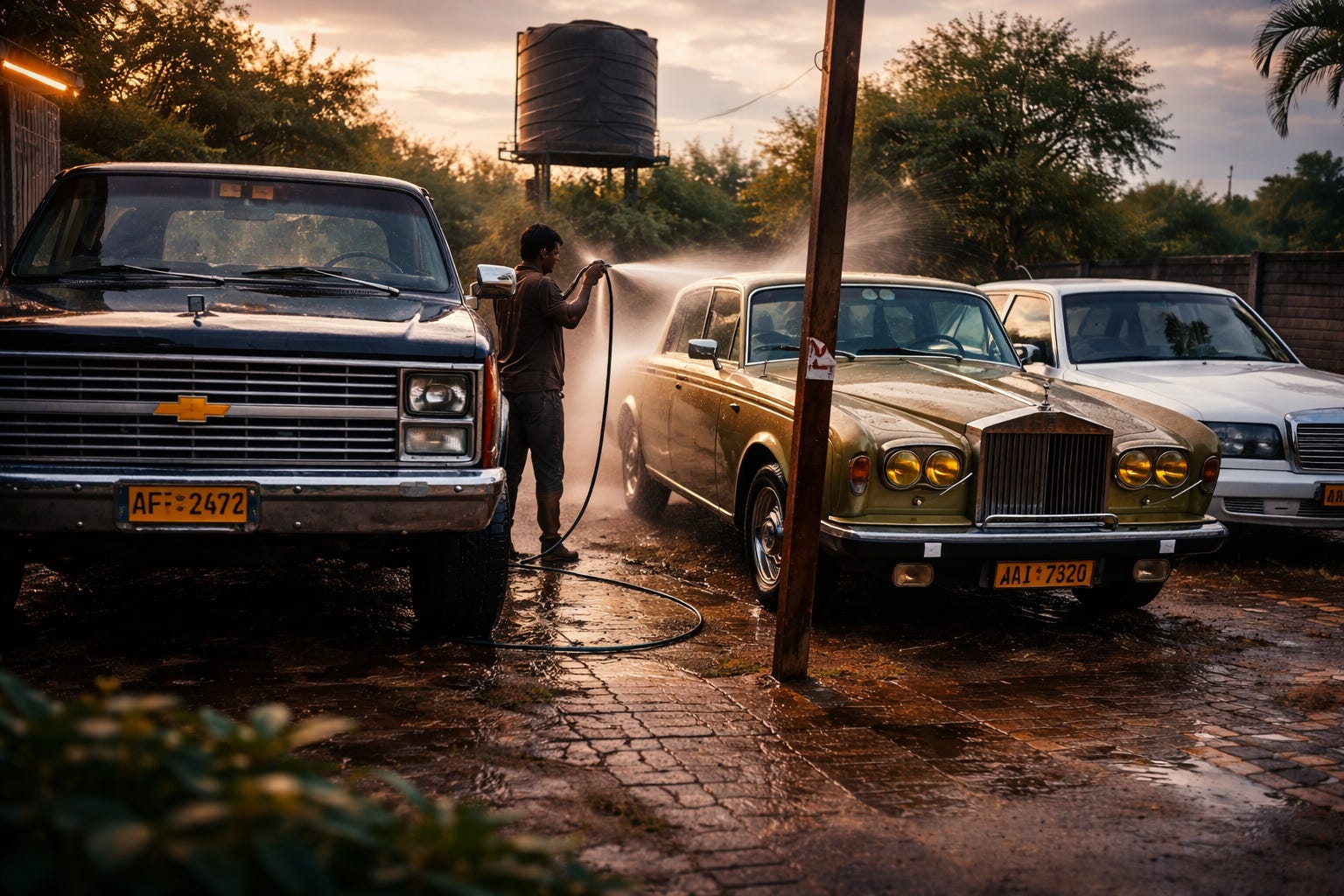
Three cars sat in the washbay. The evening light gently touched their chrome. Water followed the old lines in the metal, showing their age. It felt indulgent as much as it sounds poetic. I’ve been around these old pieces of metal long enough, but something a bout this moment hit differently. Just a day ago, a boy about 10 walked up to me in the parking lot and asked, “Is this a car from the eighties?” He had been wondering from a distance until his grandma gave him permission to talk to a stranger. His voice rang in my head as I performed my Sunday afternoon ritual.
From left to right: 43 years. 46 years. 45 years.
Older than many post-independence promises. Older than some of the institutions that claim to define modernity. Older than certain development models that arrived loudly and quietly faded.
And yet, they run with a degree of reliability that surpasses that of some modern machines. This detail and the voice of a 10-year-old boy changed everything. I almost screamed, “Eureka,” as Archimedes did…
“Longevity is not an aesthetic. It is a philosophy.”
We live in a world that worships the new.
New government.
New phone.
New framework.
New ideology.
New saviour.
Replacement has become our instinct. I’ve often been asked why I seem obsessed with old machinery, and I’ve often said, “It helps me stay grounded”. This eureka moment gave clarity to a notion I’ve understood all my life:
“African civilisation was not originally built on replacement. It was built on maintenance and continuity.”
The Great Zimbabwe walls were not rebuilt every generation; they were cared for and kept standing. The terraced hills of Ethiopia were not redesigned each season; they were looked after. Knowledge was passed down by word of mouth because continuity mattered more than novelty.
The rhythm of the village was not disruption, it was preservation.
Land was rotated.
Tools were repaired.
Names were inherited.
Memory was curated.
Continuity was a discipline.
Somewhere along the way, we were convinced that development means discarding what came before (there are scriptures to fan this fire). That progress is visible only when it is imported. That value expires unless externally validated.
But a 46-year-old machine running smoothly challenges that story. It says: longevity is not backwardness.
Keeping something alive for four decades requires more than money, though the common question I get is “How much?” The frankest response I gave someone was “You have to be mechanically minded” because keeping these living machines requires a relationship.
You must know the sound of the engine when it is well.
You must notice the vibration when something shifts.
You must anticipate failure before it becomes collapse.
And, you must be willing to take off your jacket and fold your sleeves straight after dinner in a fancy restaurant, if the car has forgotten it’s time to go home. The difference between this situation and a less embarrassing one where you drive off like a boss is attentiveness, not just mechanical literacy.
And attentiveness was once central to African ways of being.
Precolonial societies survived not because they were primitive, but because they were observant. Rain patterns were studied. Soil was read. Animal behaviour was interpreted. Systems were maintained through an intimate relationship with the environment.
Maintenance was not a chore; it was intelligence applied over time.
We were not originally a civilisation of disposability; waste wasn’t an integral part of our living as it now is. We were a civilisation of stewardship.
Modern education, imported religions and traditions subtly trained us otherwise.
Believe in the system.
Believe in the institution.
Believe in the donor.
Believe in the expert.
But, hesitate to believe in your own sustained competence, to a point where, in some spaces, the doubt is so deep that excellence from a dark-skinned man feels suspicious unless externally endorsed.
We became fluent in admiration and uncertain in execution.
It is a quiet psychological shift, but its consequences are devastating.
If you convince a people that capacity is external, they will wait.
If you convince them that longevity requires outside intervention, they will outsource maintenance.
If you persuade them that survival is in the hands of the gods, they will never study discipline.
The flood of thought felt like an out-of-body experience, that realisation that nothing in the washbay was luck or an act of the gods.
Those machines endured because someone learned.
Because someone persisted.
Because someone refused to surrender to entropy.
And along the way, I’ve also played my part. That is not vanity. That is agency.
Africa’s historical genius was not industrial acceleration; our ecological and social realities demanded resilience more than mechanisation.
Communal systems endured centuries.
Kinship networks absorbed shocks.
Oral archives preserved law, genealogy, and philosophy without the aid of printing presses. I’ve often said, “Not everything deserves to be written because writing creates a sense of permanency for things that ought pass and be forgotten.”
No, we did not lack sophistication.
We valued sustainability over spectacle.
And perhaps that is why modern narratives unsettle us. They reward disruption. They measure value by speed. They equate age with irrelevance, but this is a topic I’ve covered elsewhere in an article titled “When the Matriarch Falls”
Civilisations are not built by novelty alone; they are built by maintenance and gradual increments.
A people who can sustain what they build are more powerful than a people who can merely construct.
Construction is momentary, maintenance is generational.
Forty-six years is not symbolic. It is empirical.
Rubber degrades.
Metal fatigues.
Paint oxidises.
To keep something functioning across decades is to argue against inevitability. It is to declare:
“Decay is natural. Neglect is optional.”
That sentence may be more political than it sounds.
Because what applies to machinery applies to institutions.
To language.
To memory.
To dignity.
It’s the maintenance of the above or lack of, that leads to the collapse of civilisations, much as Viktor Frankl observed in the Nazi camps that a man would die long before his body gave way first, he would lose the will (Paraphrased from the book Man’s Search for Meaning by Victor Frankel). Civilisations are no different. Collapse begins in attention long before it appears in stone.
When knowledge transmission breaks.
When stewardship is abandoned.
When belief in capacity erodes. So does a civilisation, a culture, a people.
The washbay offered a quiet correction.
Before we believe in reform.
Before we believe in imported transformation.
Before we believe in rescue narratives.
We must believe in this:
Human capacity compounds.
Skill can be cultivated.
Longevity can be engineered.
Continuity can be chosen.
The miracle is not survival.
The miracle is sustained attention.
Perhaps what we need is not a new ideology.
Perhaps what we need is to remember that we come from a civilisation that knew how to maintain.
And if we recover that confidence, not in a loud or dramatic way, but steadily, time itself becomes less frightening.
We were never meant to be a disposable people.
I hope to meet the boy from the parking lot someday, and whichever car he sees, he will not see an antique. He will see proof that time is negotiable.
And perhaps one day, when something in his own life threatens to decay, he will remember:
Forty-six years.
And sleeves rolled up.